 Add to Chrome
 Add to Firefox
 Add to Edge
Dualband OFDM Delay Estimation for Multi-Target Localization
Jan 26, 2026
Integrated localization and communication systems aim to reuse communication waveforms for simultaneous data transmission and localization, but delay resolution is fundamentally limited by the available bandwidth. In practice, large contiguous bandwidths are difficult to obtain due to hardware constraints and spectrum fragmentation. Aggregating non-contiguous narrow bands can increase the effective frequency span, but a non-contiguous frequency layout introduces challenges such as elevated sidelobes and ambiguity in delay estimation. This paper introduces a point-spread-function (PSF)-centric framework for dual-band OFDM delay estimation. We model the observed delay profile as the convolution of the true target response with a PSF determined by the dual-band subcarrier selection pattern, explicitly linking band configuration to resolution and ambiguity. To suppress PSF-induced artifacts, we adapt the RELAX algorithm for dual-band multi-target delay estimation. Simulations demonstrate improved robustness and accuracy in dual-band scenarios, supporting ILC under fragmented spectrum.

Inter-patient ECG Arrhythmia Classification with LGNs and LUTNs
Jan 16, 2026Deep Differentiable Logic Gate Networks (LGNs) and Lookup Table Networks (LUTNs) are demonstrated to be suitable for the automatic classification of electrocardiograms (ECGs) using the inter-patient paradigm. The methods are benchmarked using the MIT-BIH arrhythmia data set, achieving up to 94.28% accuracy and a $jκ$ index of 0.683 on a four-class classification problem. Our models use between 2.89k and 6.17k FLOPs, including preprocessing and readout, which is three to six orders of magnitude less compared to SOTA methods. A novel preprocessing method is utilized that attains superior performance compared to existing methods for both the mixed-patient and inter-patient paradigms. In addition, a novel method for training the Lookup Tables (LUTs) in LUTNs is devised that uses the Boolean equation of a multiplexer (MUX). Additionally, rate coding was utilized for the first time in these LGNs and LUTNs, enhancing the performance of LGNs. Furthermore, it is the first time that LGNs and LUTNs have been benchmarked on the MIT-BIH arrhythmia dataset using the inter-patient paradigm. Using an Artix 7 FPGA, between 2000 and 2990 LUTs were needed, and between 5 to 7 mW (i.e. 50 pJ to 70 pJ per inference) was estimated for running these models. The performance in terms of both accuracy and $jκ$-index is significantly higher compared to previous LGN results. These positive results suggest that one can utilize LGNs and LUTNs for the detection of arrhythmias at extremely low power and high speeds in heart implants or wearable devices, even for patients not included in the training set.
CASH: Context-Aware Smart Handover for Reliable UAV Connectivity on Aerial Corridors
Aug 05, 2025Urban Air Mobility (UAM) envisions aerial corridors for Unmanned Aerial Vehicles (UAVs) to reduce ground traffic congestion by supporting 3D mobility, such as air taxis. A key challenge in these high-mobility aerial corridors is ensuring reliable connectivity, where frequent handovers can degrade network performance. To resolve this, we present a Context-Aware Smart Handover (CASH) protocol that uses a forward-looking scoring mechanism based on UAV trajectory to make proactive handover decisions. We evaluate the performance of the proposed CASH against existing handover protocols in a custom-built simulator. Results show that CASH reduces handover frequency by up to 78% while maintaining low outage probability. We then investigate the impact of base station density and safety margin on handover performance, where their optimal setups are empirically obtained to ensure reliable UAM communication.
Building a real-time physical layer labeled data logging facility for 6G research
Oct 02, 2024
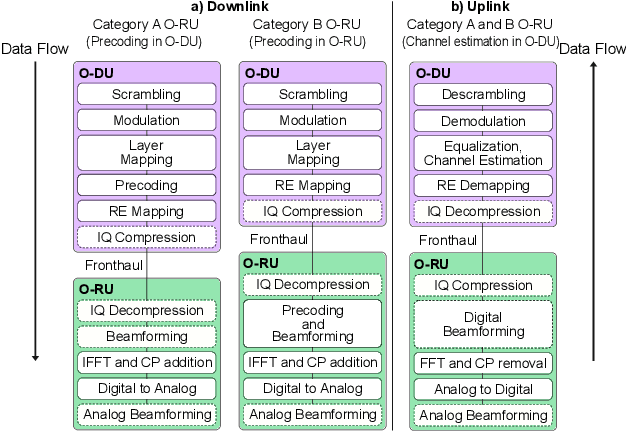
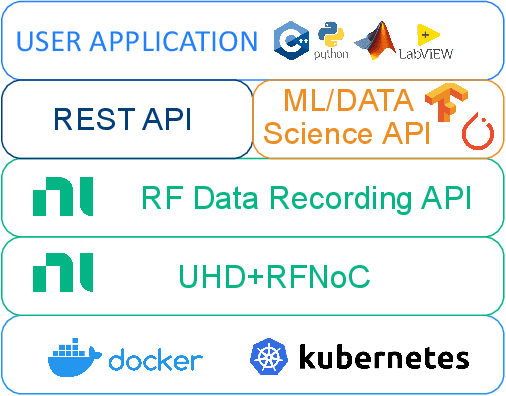
This work describes the architecture and vision of designing and implementing a new test infrastructure for 6G physical layer research at KU Leuven. The Testbed is designed for physical layer research and experimentation following several emerging trends, such as cell-free networking, integrated communication, sensing, open disaggregated Radio Access Networks, AI-Native design, and multiband operation. The software is almost entirely based on free and open-source software, making contributing and reusing any component easy. The open Testbed is designed to provide real-time and labeled data on all parts of the physical layer, from raw IQ data to synchronization statistics, channel state information, or symbol/bit/packet error rates. Real-time labeled datasets can be collected by synchronizing the physical layer data logging with a positioning and motion capture system. One of the main goals of the design is to make it open and accessible to external users remotely. Most tests and data captures can easily be automated, and experiment code can be remotely deployed using standard containers (e.g., Docker or Podman). Finally, the paper describes how the Testbed can be used for our research on joint communication and sensing, over-the-air synchronization, distributed processing, and AI in the loop.
3D Non-Stationary Channel Measurement and Analysis for MaMIMO-UAV Communications
Oct 10, 2023Unmanned aerial vehicles (UAVs) have gained popularity in the communications research community because of their versatility in placement and potential to extend the functions of communication networks. However, there remains still a gap in existing works regarding detailed and measurement-verified air-to-ground (A2G) Massive Multi-Input Multi-Output (MaMIMO) channel characteristics which play an important role in realistic deployment. In this paper, we first design a UAV MaMIMO communication platform for channel acquisition. We then use the testbed to measure uplink Channel State Information (CSI) between a rotary-wing drone and a 64-element MaMIMO base station (BS). For characterization, we focus on multidimensional channel stationarity which is a fundamental metric in communication systems. Afterward, we present measurement results and analyze the channel statistics based on power delay profiles (PDPs) considering space, time, and frequency domains. We propose the stationary angle (SA) as a supplementary metric of stationary distance (SD) in the time domain. We analyze the coherence bandwidth and RMS delay spread for frequency stationarity. Finally, spatial correlations between elements are analyzed to indicate the spatial stationarity of the array. The space-time-frequency channel stationary characterization will benefit the physical layer design of MaMIMO-UAV communications.
Evolution of Non-Terrestrial Networks From 5G to 6G: A Survey
Jul 14, 2021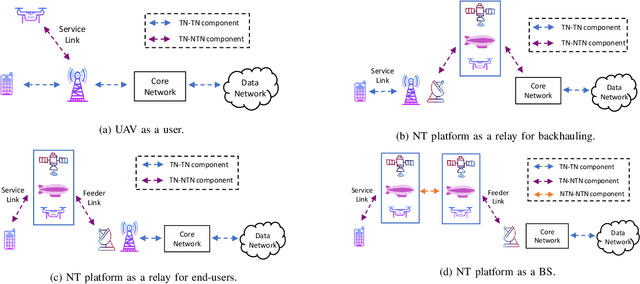
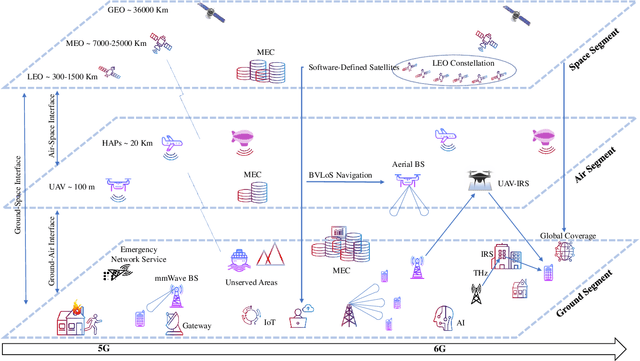
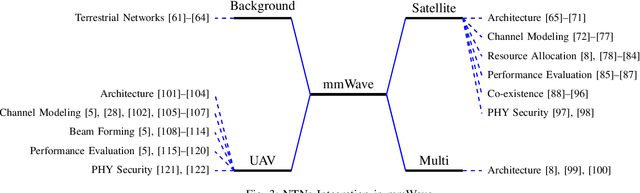
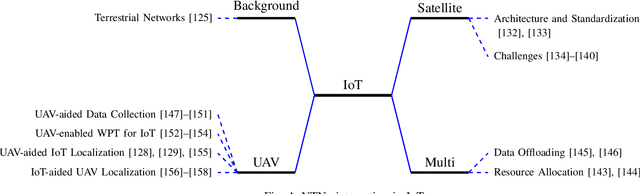
Non-terrestrial networks (NTNs) traditionally had certain limited applications. However, the recent technological advancements opened up myriad applications of NTNs for 5G and beyond networks, especially when integrated into terrestrial networks (TNs). This article comprehensively surveys the evolution of NTNs highlighting its relevance to 5G networks and essentially, how it will play a pivotal role in the development of 6G and beyond wireless networks. The survey discusses important features of NTNs integration into TNs by delving into the new range of services and use cases, various architectures, and new approaches being adopted to develop a new wireless ecosystem. Our survey includes the major progresses and outcomes from academic research as well as industrial efforts. We first start with introducing the relevant 5G use cases and general integration challenges such as handover and deployment difficulties. Then, we review the NTNs operations in mmWave and their potential for the internet of things (IoT). Further, we discuss the significance of mobile edge computing (MEC) and machine learning (ML) in NTNs by reviewing the relevant research works. Furthermore, we also discuss the corresponding higher layer advancements and relevant field trials/prototyping at both academic and industrial levels. Finally, we identify and review 6G and beyond application scenarios, novel architectures, technological enablers, and higher layer aspects pertinent to NTNs integration.